
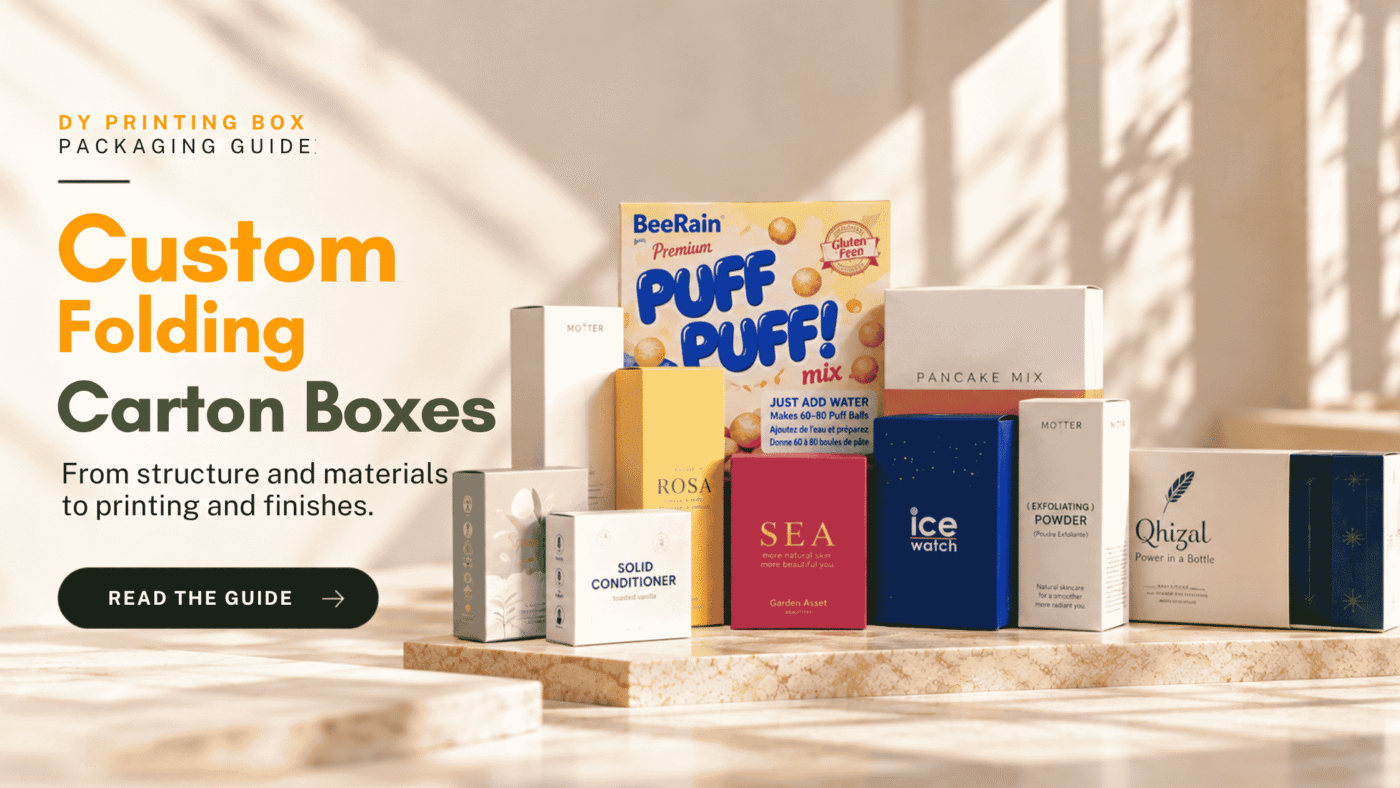
Custom Folding Carton Boxes: A Guide to Styles, Materials, Printing & Finishing
Custom folding carton boxes are one of the most versatile packaging solutions for retail products. From cosmetics and skincare to food, supplements, candles and everyday consumer goods, folding cartons can be customized to fit the product, support the brand and create the right presentation.
But creating a custom box involves more than choosing a size and adding a logo.
The box style, paper stock, printing method and finishing options all affect how the final packaging looks, feels and performs. Understanding these choices can help you create packaging that works for both your product and your budget.
Here is a practical guide to the main options to consider when creating a custom folding carton box.
1. Choose the Right Folding Carton Style
The first step is choosing a box structure that works for your product.
Different folding carton styles provide different levels of convenience, presentation and support. Common options include:
Straight Tuck End (STE)
A clean and versatile folding carton style with both closure flaps folding in the same direction. It is commonly used for cosmetics, skincare, personal care products and lightweight retail items.
Reverse Tuck End (RTE)
Similar to a straight tuck end box, but the top and bottom flaps close in opposite directions. This structure is efficient to produce and works well for many everyday retail products.
Auto Bottom Box
The bottom automatically locks into position when the box is opened. It provides more support than a standard tuck-bottom carton and is useful for products that require a stronger base.
Sleeve & Tray Box
A two-piece folding carton structure consisting of an outer sleeve and an inner tray. It creates a more premium opening experience and can be combined with custom inserts to hold and present the product.
Custom Structures
Some products require a structure designed specifically around the product. Custom openings, inserts, windows, compartments or other structural features can be incorporated depending on the packaging requirements.
The right structure depends on the product’s dimensions, weight, presentation and how the box will be packed and used.
2. Select the Right Paper Stock
Paper selection affects both the appearance and strength of a folding carton.
White Cardstock
White cardstock provides a clean printing surface and is an excellent choice when accurate colours, detailed graphics or premium branding are important.
Different paper thicknesses can be selected depending on the size and weight of the product.
Kraft Paper
Kraft paper provides a natural, warm appearance and works especially well for brands looking for a simple, organic or craft-inspired presentation.
Printing on kraft paper behaves differently from printing on white cardstock because the natural brown paper colour becomes part of the final appearance. Simple graphics and carefully selected colours often work particularly well.
The best paper stock is not necessarily the thickest option. Box dimensions, product weight, box structure and desired appearance should all be considered when selecting the material.
3. Choose the Printing Method: Digital or Offset
Both digital and offset printing can produce custom folding cartons, but they are suited to different production needs.
Digital printing is especially useful for prototypes, product testing and short production runs. It allows brands to produce smaller quantities without the setup requirements associated with traditional offset production.
Offset printing is generally better suited to larger production quantities and projects requiring greater control over colour, Pantone colours, premium print quality and a wider range of finishing options.
The best printing method depends on more than quantity. Your artwork, colour requirements, finishing, production timeline and the stage of your product launch should also be considered.
We will explore these differences in more detail in our upcoming guide to Digital Printing vs. Offset Printing for Custom Packaging.
4. Add Special Finishing to Make Your Packaging Stand Out
Printing creates the artwork, but finishing can completely change how a package looks and feels.
Depending on the design and production method, folding cartons can incorporate finishing options such as:
Foil Stamping
Metallic foil can highlight logos, typography or selected design elements and create a more premium appearance.
Special or Holographic Foil
Specialty foils can produce subtle colour shifts or reflective effects that change depending on the viewing angle and light.
Spot UV
A glossy coating applied only to selected areas can create contrast against a matte surface and draw attention to logos, patterns or other design details.
Embossing and Debossing
Selected elements can be raised or pressed into the paper to introduce a tactile dimension to the packaging.
Matte or Gloss Lamination
Lamination changes the overall surface appearance while also providing additional protection to the printed carton.
Special finishing does not need to cover the entire box. Often, using one carefully selected finishing technique on a logo or key design element creates a stronger and more sophisticated result.
5. Why Custom Size Matters
Good packaging should fit the product rather than forcing the product to fit an existing box.
A custom-size folding carton can help reduce unnecessary empty space, improve product presentation and create a more intentional unboxing experience.
For some products, the box itself provides enough support. Others may benefit from a custom paper insert or internal structure that keeps the product in position.
When developing a custom box, it is important to consider not only the external dimensions but also how the product will sit inside the packaging.
This is especially important for products such as cosmetics, skincare, fragrances and other items where presentation is part of the customer experience.
6. From Prototype to Full Production
Not every packaging project needs to begin with a large production order.
For a new product, a digitally printed prototype or short production run can be a practical way to test:
- Box dimensions and structure
- Artwork placement
- Product fit
- Overall presentation
- Customer or market response
Once the structure and design are confirmed and the product is ready for larger-scale production, offset printing may provide additional options for colour control, special finishing and production efficiency.
This allows packaging to develop along with the product rather than requiring every brand to begin with the same production process.
7. Plan a Realistic Budget for Custom Packaging
One of the most important things to understand about custom packaging is that it is different from ordering standard printed products such as business cards or flyers.
A custom folding carton involves several stages before the finished boxes are ready. Depending on the project, this may include structural setup, dieline preparation, prepress, printing setup, die cutting, finishing, folding and gluing.
These production steps affect both the cost and turnaround time of custom packaging.
Why Quantity Matters
Many packaging production costs are associated with setting up the job rather than simply producing each individual box.
Although these setup costs may not appear as separate charges on your quotation, they are still part of the overall production cost.
This is why producing a very small quantity of fully customized packaging can result in a relatively high cost per box. As the production quantity increases, those setup costs are spread across more boxes and the unit cost can become significantly more economical.
Start with Your Product, Quantity and Budget
Before choosing every material, printing method and special finish, it helps to have a realistic idea of:
- How many boxes you need
- Your target packaging budget
- Whether you are testing a new product or preparing for regular production
- Which packaging features are essential to your brand
- Which features are optional
For example, a new brand testing a product may benefit from starting with a simpler structure or short-run digital production rather than immediately investing in a more complex offset-printed package with multiple special finishes.
On the other hand, a product entering regular production may benefit from a larger quantity, offset printing and additional finishing options.
The goal is not simply to create the most elaborate package possible. It is to find the right packaging solution for your product, production stage and budget.
We will explore this topic further in our upcoming guide on how to plan a realistic budget for custom packaging.
8. What Information Do You Need for a Custom Folding Carton Quote?
Providing the basic packaging specifications helps us recommend the right production solution and prepare a more accurate quotation.
The most useful information includes:
Box size — Length × Width × Height
Quantity — How many boxes you need
Box style — If known
Paper stock — White cardstock, kraft or another preferred material
Printing — Colours and artwork requirements
Special finishing — Foil, Spot UV, embossing, lamination or other requirements
Artwork or dieline — If already available
If you are not sure about every specification, that is completely fine. Product dimensions, quantity and a description of the packaging you are trying to create are often enough to start the conversation.
Create the Right Folding Carton for Your Product
A successful folding carton brings together structure, material, printing and finishing.
There is no single box style or printing method that is right for every product. The best solution depends on what you are packaging, how you want the product to be presented, your production quantity and the stage of your business.
At DY Printing Box, we produce custom folding carton packaging for different products and production needs, from short-run digital packaging and prototypes to custom offset-printed production boxes.
Not sure which folding carton is right for your product?
Tell us your product size, quantity and packaging requirements. We can help you explore the right box style, paper stock, printing method and finishing options for your project.
Get a Custom Folding Carton Quote →