
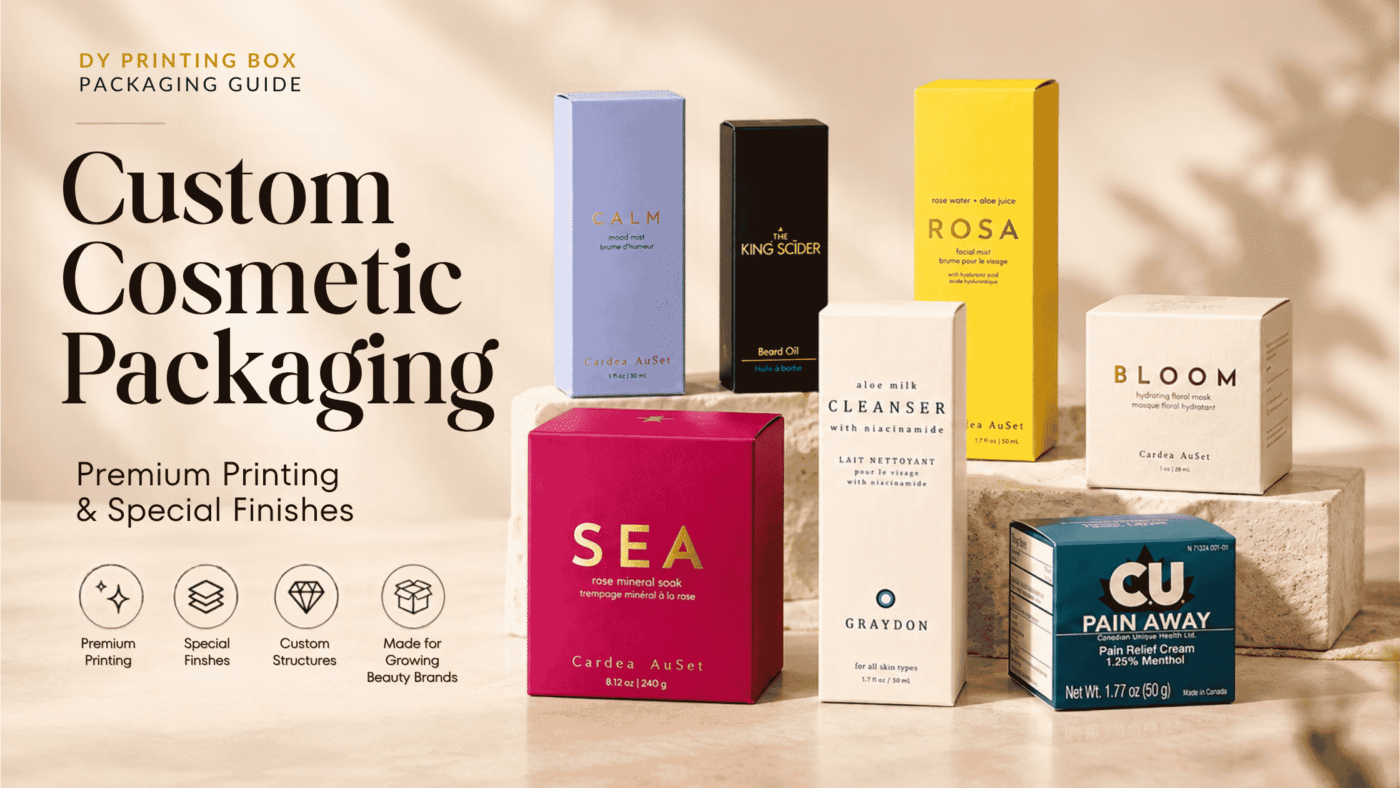
In the beauty industry, packaging is often the first physical experience a customer has with your brand.
Before they open a skincare box, pick up a serum bottle or try a cosmetic product, the packaging has already communicated something about the product inside.
That is why custom cosmetic packaging requires more than simply placing a logo on a box. Colour accuracy, paper selection, surface finish, structure and small design details all contribute to how customers perceive the quality of your brand.
For growing beauty brands, the goal is not necessarily to create the most complicated packaging. It is to choose the right combination of printing, materials, structure and finishing to create a package that feels intentional and consistent with the product inside.
1. Why Cosmetic Packaging Needs More Attention to Detail
Beauty packaging often relies heavily on visual details.
Soft neutral colours, delicate typography, metallic accents, minimalist graphics and subtle surface effects are common in cosmetic and skincare packaging. These elements may look simple on a computer screen, but producing them consistently on a printed box requires careful attention to materials and printing.
Small differences in colour, coating or finishing can noticeably change the final appearance of the package.
This is especially important when packaging is part of a larger brand system. A skincare line may include several products with different box sizes, but customers should still recognize them as belonging to the same brand.
Good cosmetic packaging therefore needs to balance three things:
Brand presentation, print quality and practical product protection.
2. Premium Printing Makes a Difference
High-quality artwork needs the right printing method to reproduce it effectively.
For cosmetic packaging, offset printing is often selected for larger production quantities where colour consistency, detailed artwork and greater control over the final appearance are important.
Offset printing can also provide more flexibility for projects requiring Pantone (PMS) colours or premium finishing processes.
Digital printing, however, still has an important role.
For a new beauty product, prototype or short production run, digital printing can provide a practical way to test the packaging before moving into larger-scale production.
The right choice depends on your quantity, artwork, colour requirements, finishing and stage of production.
If you are deciding between the two methods, our guide to Digital Printing vs. Offset Printing for Custom Packaging explains the differences in more detail.
3. Special Finishing Creates the Premium Look
Special finishing is one of the most effective ways to give cosmetic packaging a distinctive appearance.
The key is not to use every available finishing technique. Instead, finishing should support the overall design and draw attention to the details that matter most.
Foil Stamping
Gold, silver, coloured and specialty foils can be used to highlight a logo, product name or selected graphic element.
Foil works particularly well when the surrounding design is relatively clean, allowing the metallic detail to become a focal point.
Embossing & Debossing
Embossing raises selected areas of the design, while debossing presses them into the paper.
Both techniques introduce a tactile element that customers can see and feel. They can be especially effective for logos, patterns and minimalist packaging where subtle details are important.
Spot UV
Spot UV adds a glossy coating to selected areas of the box.
When combined with a matte surface, the contrast between glossy and matte areas can create a sophisticated effect without adding additional colours to the design.
Matte & Gloss Lamination
Lamination affects the overall appearance and feel of the package while also providing additional surface protection.
Matte lamination can create a softer, more refined appearance, while gloss lamination produces a brighter and more reflective surface.
Specialty & Holographic Foils
For brands looking for a more distinctive visual effect, specialty foils can introduce colour shifts, reflective surfaces or other effects that change with light and viewing angle.
The right finishing technique depends on the brand. A subtle embossed logo may be more effective for one product, while another may benefit from metallic foil or Spot UV.
4. The Right Structure Supports the Product
Beautiful printing is only one part of good cosmetic packaging.
The box also needs to protect and present the product properly.
Cosmetic and skincare products can include bottles, jars, tubes, droppers, makeup products and other containers in many different shapes and weights.
The folding carton structure should therefore be selected around the actual product.
For some products, a standard folding carton structure provides enough support. Others may benefit from a custom insert that holds the product securely in position.
A well-designed insert can also improve presentation by controlling exactly how the product appears when the customer opens the package.
5. Custom Size Creates a More Finished Presentation
A beautifully printed box can still feel wrong if the product does not fit properly inside.
Too much empty space can make packaging feel oversized, while a box that is too tight can make packing difficult or provide inadequate protection.
Custom sizing allows the packaging to be developed around the actual dimensions of the product.
When determining the box size, consider:
- Product dimensions
- Product weight
- Insert requirements
- How the product will be placed inside
- Opening experience
- Shelf presentation
For cosmetic packaging, these details can make a significant difference in how finished and professional the final package feels.
6. Premium Packaging Does Not Mean Adding Everything
One of the biggest misconceptions about premium packaging is that more finishing automatically creates a better result.
It does not.
Foil, embossing, Spot UV, specialty coatings and other finishing techniques can all create beautiful effects, but using too many at once can make the design feel busy and unnecessarily increase production costs.
Often, one or two carefully selected details are enough.
For example:
Matte lamination + gold foil can create an elegant premium appearance.
Minimal printing + embossing can produce a subtle, tactile design.
Matte surface + Spot UV can create contrast without introducing additional colours.
The best finishing choices are the ones that support the brand rather than compete with it.
Great cosmetic packaging comes from the combination of accurate printing, thoughtful finishing and the right structure — not simply from adding more decoration.
7. Consider Your Production Quantity and Budget
Custom cosmetic packaging involves more than printing artwork onto a standard box.
Depending on the project, production may involve printing setup, custom die cutting, lamination, foil stamping, Spot UV, embossing, folding, gluing and custom inserts.
Each additional process can affect both cost and production time.
This makes quantity and budget important considerations from the beginning of the project.
A new beauty brand testing a product may not need the same packaging solution as an established product entering regular production.
Before finalizing the packaging, consider:
- Your initial production quantity
- Expected future quantities
- Target packaging budget
- Which design elements are essential
- Which special finishes are optional
Rather than spending the budget on every available feature, it is often better to invest in the details that make the biggest difference to the brand and customer experience.
8. What Do You Need for a Custom Cosmetic Packaging Quote?
The more information available at the beginning of a project, the easier it is to recommend the right packaging solution.
Useful information includes:
Product dimensions — The size of the actual bottle, jar, tube or product.
Box dimensions — If you already know the required finished size.
Quantity — Your expected production quantity.
Box style — If known, or provide a reference image.
Paper stock — White cardstock, kraft or another preferred material.
Printing requirements — CMYK, Pantone colours or other colour requirements.
Special finishing — Foil, Spot UV, embossing, lamination or other effects.
Insert requirements — If the product needs additional internal support.
Artwork or reference images — Existing artwork, dielines or packaging inspiration can help communicate the direction of the project.
You do not need to have every detail finalized before requesting a quote. Product dimensions, quantity and a clear idea of the packaging style are often enough to begin discussing the options.
Create Cosmetic Packaging That Fits Your Brand
Successful cosmetic packaging brings together visual presentation, print quality, structure and production requirements.
The goal is not simply to create a beautiful box. It is to create packaging that feels appropriate for the product, communicates the brand clearly and can be produced realistically at the quantity and budget the business needs.
At DY Printing Box, we create custom cosmetic packaging for growing beauty brands, with options including custom folding cartons, premium offset printing, short-run digital printing, custom inserts and a range of special finishing techniques.
Whether you are preparing a new product launch or moving into larger production, we can help you explore the right combination of structure, printing and finishing for your packaging.
Looking for custom cosmetic packaging?
Tell us about your product, quantity and design direction, and we can help you explore the right packaging solution for your brand.
Request a Custom Cosmetic Packaging Quote →